Dental unit waterline testing is essential, but the testing method you choose matters. Many practices use paddle tests because they are familiar and widely available. However, paddle testing can introduce variability and uncertainty, particularly when visual interpretation is required.
Sterisil developed FASTCheck15 in response to a common concern heard repeatedly from dental assistants:
Waterline testing takes too long, and it’s too hard to tell what the results actually mean.
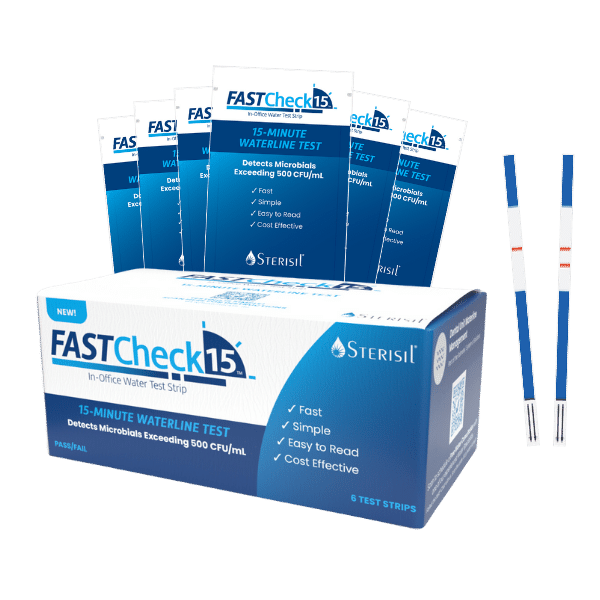
FASTCheck15 simplifies dental unit waterline monitoring by providing rapid, easy-to-interpret pass/fail results, allowing you to evaluate water quality with confidence.
This article explains the practical differences between paddle testing and FASTCheck15 test strips, and why clarity in reporting matters.
The Reality of Paddle Testing in Clinical Practice
Paddle testing requires the user to:
- Dip or expose a culture paddle to the sample
- Allow bacterial growth to develop over time, usually 48-72 hours
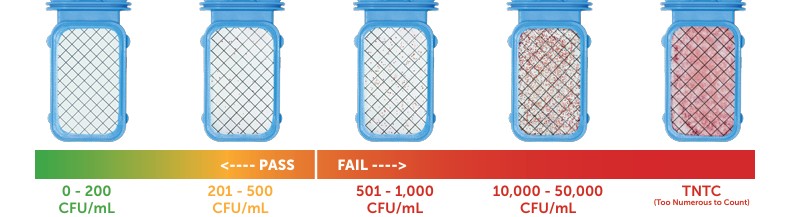
- Interpret colony formation visually against a comparison chart
In theory, this process is straightforward. In practice, several challenges arise:
- Subjective interpretation: Colony density must be visually compared to reference images. Two individuals may reasonably classify the same paddle differently.
- User error: The person who starts the test is not always the person who reads the results. It’s not uncommon to read results too early (or wait too long), accidentally disrupt environmental factors that mess with accurate results, or document results improperly.
- Non-linear comparison ranges: Some manufacturer charts skip large CFU intervals (for example, from 1,000 CFU/mL to 10,000 CFU/mL), leaving uncertainty when growth falls in-between.
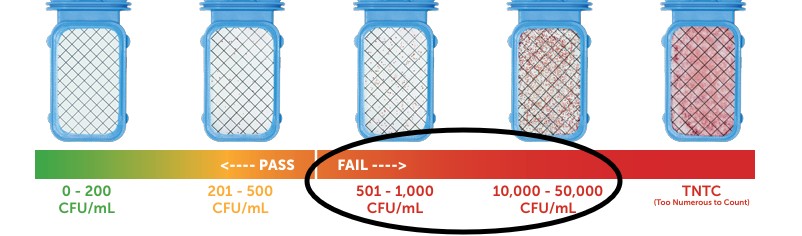
- Merged colonies and smears: When colonies cluster or streaks occur, distinguishing individual units becomes difficult.
- Environmental influence: Variations in handling, storage temperature and sunlight exposure, incubation, expiration date, and reading conditions may alter appearance.
- Time-delayed results: Paddle tests often require extended incubation before interpretation — delaying decision-making and potentially exposing patients and staff to contamination.
The result is a process that can feel less like measurement — and more like estimation.
When the goal is patient safety and compliance documentation, estimation may not provide the level of clarity practices expect.
Why Counting Colonies Isn’t Always Practical — or Realistic
Some paddle test manufacturers emphasize that their system allows for colony quantification. In real-world dental environments, this rarely occurs with precision.
Dental assistants are not working in controlled microbiology lab environments — nor should they be required to.
Instead, paddle tests are usually interpreted by comparing general density patterns against guide images. And since some interpretation charts skip wide numerical ranges, there can be significant uncertainty when results fall between reference points.
This uncertainty can affect:
- Corrective action timing
- Compliance documentation quality
- Communication with leadership or inspectors
- Confidence in reported results
When the interpretation itself is variable, the decision-making becomes harder.
FASTCheck15: Designed for Clarity, Speed, and Practical Use
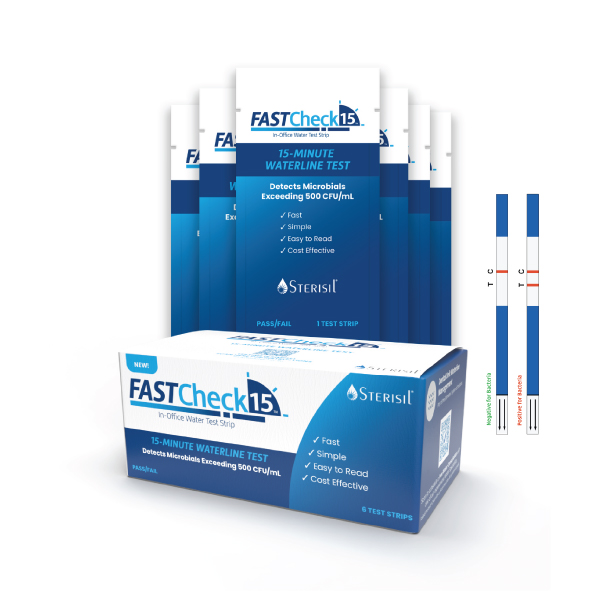
FASTCheck15 was developed to resolve these limitations. Rather than requiring estimation from colony density, FASTCheck15 provides a clear, objective pass/fail interpretation — and it only takes 15 minutes.
Key advantages include:
1. Rapid Turnaround
Results are available during the workday — not days later — allowing corrective action to begin sooner if needed.
2. Objective Interpretation
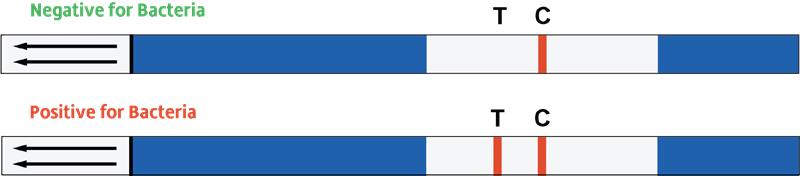
FASTCheck15 is built to support clear, binary reporting — reducing subjective variability between readers. If your water has more than 500 CFU/mL of heterotrophic bacteria (over the CDC’s limit), your test strip will indicate a fail, and if your water has less than 500 CFU/mL, your test strip will indicate a pass.
3. Workflow Compatibility
Testing integrates smoothly into monthly responsibilities, without requiring microbiology expertise.
4. Streamlined Documentation
Pass/fail outcomes are easier to communicate, track, and defend during inspections.
5. Consistency Across Operators
Whether a new dental assistant or an experienced team member is reading results, interpretation remains consistent.
The goal is not just speed — but clarity, reproducibility, and confidence in water quality status.
A Practical Comparison
| Factor | Paddle Tests | FASTCheck15 |
| Result Type | Visual interpretation; colony density compared to chart | Objective pass/fail |
| Interpretation Certainty | Variable; dependent on reader judgment | High; built for clarity |
| Time to Result | 48-72 hours | 15 minutes |
| Ease of Use | Moderate; requires chart reference and visual judgment | High; designed for clinical workflow |
| CFU Estimation | Approximate | Not required |
| Documentation | Interpretation notes required | Straightforward pass/fail record |
Why This Matters for Dental Assistants
Dental assistants carry significant responsibility in infection prevention, often without recognition. Using a testing system that reduces ambiguity helps support:
- Professional confidence
- Regulatory assurance
- Patient safety
- Operational efficiency
Paddle tests work, but they rely heavily on subjective interpretation and visual estimation. FASTCheck15 delivers rapid, objective, easy-to-read pass/fail results designed for real-world clinical environments.
When the stakes involve patient safety and compliance integrity, clarity matters.
If your office is looking to simplify waterline testing while improving the clarity and confidence of reported results, explore how FASTCheck15 supports accurate DUWL monitoring without the uncertainty associated with paddle interpretation.
Learn more about FASTCheck15 and determine whether it may be a better fit for your infection-prevention program.