Article By: Mark Warren, Water Safety Specialist
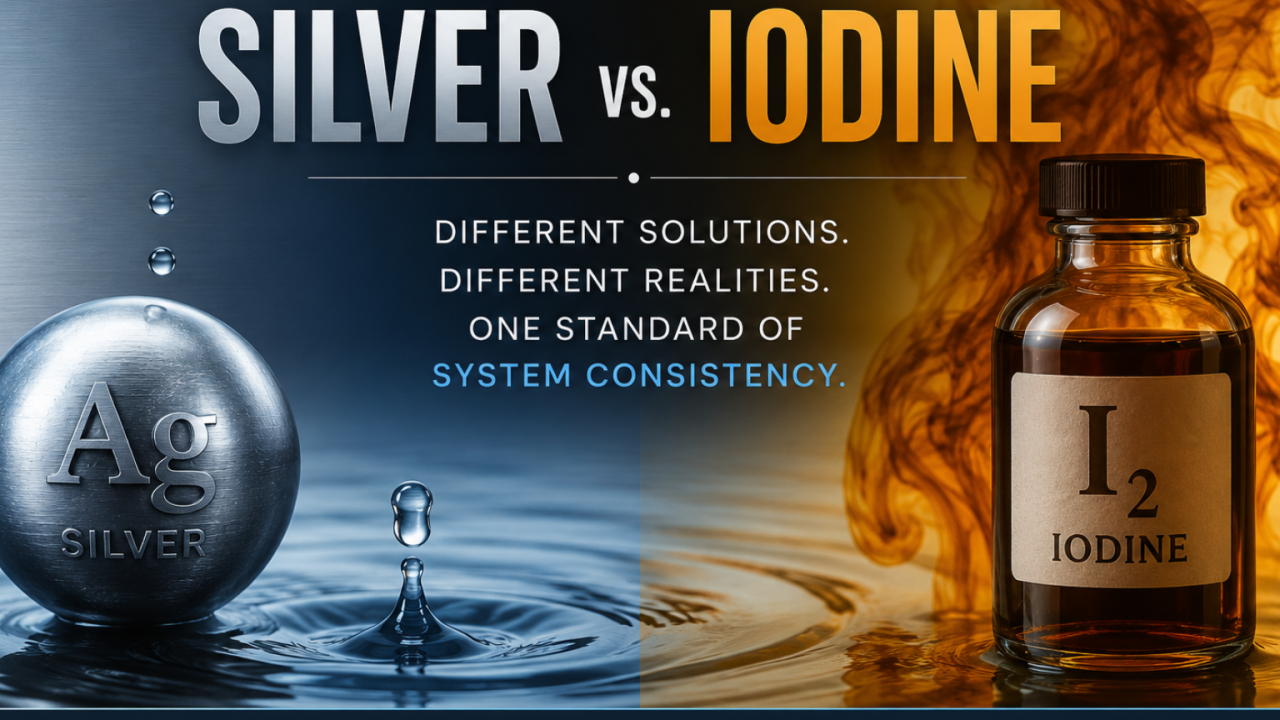
In dentistry, “safe water” isn’t just about drinking—it’s about patient exposure through handpieces, ultrasonic scalers, and air/water syringes, plus the reality that dental unit waterlines (DUWLs) are small-bore plastic tubing that readily develops biofilm. So when you compare iodine and silver as antimicrobial water treatments, the dental question becomes: Which option better supports consistent microbial control, patient acceptability, and long-run clinical practicality? In most dental contexts, silver-based approaches are the stronger fit.
1) Dental water is a biofilm problem—silver is built for residual control.
Iodine is typically used as an immediate-dose disinfectant (common in backcountry/emergency scenarios). It can work well acutely, but dentistry needs ongoing suppression of microbial regrowth and biofilm seeding inside DUWLs.
Silver, by contrast, is widely used specifically because silver ions provide persistent antimicrobial activity in water systems and on surfaces. In dental waterline applications, the evidence base includes commercial and investigational systems that use silver (often paired with other agents such as hydrogen peroxide) to reduce DUWL contamination. A systematic review focused on silver for DUWL decontamination found supportive evidence of antimicrobial efficacy, including silver-based regimens used against diverse DUWL microorganisms.
Clinical translation: In a practice that wants stable water quality day after day—not just “a one-time kill”—residual activity matters, and silver aligns better with that requirement.
2) Dentistry has a clear microbial benchmark—silver programs are commonly designed to help hit it.
CDC guidance emphasizes that DUWLs should be treated regularly and references the widely used quality target of ≤500 CFU/mL of heterotrophic water bacteria (EPA drinking water benchmark). This isn’t just a theoretical goal: practices have to maintain output water quality consistently across chairs, over time, and after weekends/closures.
Silver-based protocols are frequently positioned as maintenance solutions (often as part of a system: chemical treatment + adherence to manufacturer instructions + monitoring). Iodine can disinfect, but it’s less commonly used as a long-term, chairside-maintenance strategy for DUWL biofilm control in modern dental workflows.
3) Patient safety and long-term exposure: iodine carries a thyroid “asterisk.”
The key clinical downside of iodine is not that it doesn’t work—it’s that repeated ingestion/exposure raises thyroid concerns in susceptible individuals and can be problematic as a long-term routine disinfectant.
- WHO notes that iodine for drinking-water disinfection should be weighed as a risk/benefit decision, specifically calling out concern for thyroid impacts over short and long-term exposure, and also notes iodine is not generally recommended for long-term disinfection.
- Clinical literature reviewing iodine disinfection highlights thyroid disorders as the major health concern with excess iodine ingestion.
- Endocrinology literature documents that excess iodine exposure can precipitate thyroid dysfunction in some individuals.
Dental lens: Your patients include pregnant individuals, older adults, and people with thyroid disease risk factors—so choosing a long-term water treatment strategy that avoids avoidable endocrine baggage is just smart risk management.
4) Taste/odor and compliance: iodine creates a “people won’t use it” problem.
Iodine-treated water often has a noticeable taste/odor profile (and some individuals experience GI upset), which is exactly the kind of friction that causes staff workarounds and inconsistent adherence in real life. Silver-based treatments are typically lower-impact on taste/odor, which is why they’re used as residual biocides in sensitive settings where acceptability and ongoing use matter (including aerospace potable water research and programs).
5) Regulatory comfort: silver has an established drinking-water reference point.
Silver has a U.S. EPA secondary drinking water standard (SMCL) of 0.10 mg/L, which is a guideline primarily addressing nuisance/aesthetic considerations rather than an enforceable health-based maximum contaminant level. That matters in dentistry because it’s one more signal that silver can be managed within recognized water-quality frameworks when used correctly.
(Important nuance: excessive silver exposure can cause cosmetic discoloration issues like argyria—so the point is not “more silver is better,” it’s controlled dosing within product instructions and water standards.)
Practical Takeaway for Dental Teams
If your goal is to reliably meet DUWL quality expectations while minimizing patient risk and improving day-to-day usability, silver-based DUWL treatments generally outperform iodine as a long-term strategy—especially where residual antimicrobial activity and biofilm control are central.
What to do Next (Clinic-Ready)
- Align to CDC guidance: treat DUWLs regularly and follow manufacturer instructions; use flushing practices after each patient encounter for devices that enter the mouth.
- Consider silver-based DUWL protocols (often paired with complementary agents) when selecting maintenance systems for ongoing microbial suppression.
- Validate with periodic water testing to confirm you’re staying at/under accepted benchmarks (commonly ≤500 CFU/mL).
Referencias
- CDC. Best Practices for Dental Unit Water Quality.
- CDC. Infection Control: Water (DUWL overview).
- Hong F, et al. The Application of Silver to Decontaminate Dental Unit Waterlines—A Systematic Review. (2022).
- WHO. Iodine as a drinking-water disinfectant (technical guidance).
- Backer H. Use of iodine for water disinfection. (2000).
- Sohn SY, et al. Risks of Iodine Excess. Endocrine Reviews (2024).
- U.S. EPA. Drinking Water Regulations and Contaminants (NSDWR listing includes silver 0.10 mg/L).
- NASA (potable water biocide research): silver ions as residual biocide; ISS biocide context.