
Summary: Georgia’s new Dental Waterline Rule introduces mandatory testing and documentation, but many dental teams feel unprepared to implement it. With the right education tools, and specific dental waterline training, compliance becomes second nature. This blog outlines practical steps for training your staff, meeting CE requirements, and using Sterisil’s SAFEWater Solution for smooth integration.
New dental regulations can feel overwhelming—especially when they involve daily workflows and clinical safety. But Georgia’s new Dental Unit Water Quality Rule is more than just red tape. It’s a call to action for dental teams to prioritize infection control through education, systems, and teamwork.
La bonne nouvelle? Former votre équipe n’a pas besoin d’être difficile. Avec les bons conseils et les bons outils, vous pouvez transformer la conformité en confiance.
Commencez par la règle : Ce que la Géorgie exige maintenant
The rule adopted by the Georgia Board of Dentistry in February, 2025 requires:
- Utilisez une eau conforme aux normes d’eau potable : Les bureaux doivent utiliser l’eau conforme aux normes de l’EPA (≤ 500 UFC/mL).
- Tester l’eau au moins une fois par trimestre : Les bureaux doivent suivre les instructions des fabricants pour l’utilisation lors des tests de la qualité de l’eau, tester la qualité de l’eau au moins trimestriellement, et tester la qualité de l’eau dans les 30 jours suivant les modifications de la plomberie.
- Prenez des mesures correctives si un niveau inacceptable d’unités formant des colonies (UFC) est identifié.
- Enregistrez les résultats des tests pendant au moins 5 ans, incluant les dates d’enregistrement, la personne qui effectue les tests et les rapports d’une entité de test indépendante.
- Formation et éducation : Déjà en vigueur, mais il est bon de se rappeler pour les hygiénistes, que les heures de l’exigence minimale de formation continue incluent l’éducation et la formation sur le contrôle des infections dans la pratique de l’hygiène dentaire, ce qui inclut l’éducation et la formation sur les conduites d’eau des unités dentaires.
Comprendre la règle est la première étape pour élaborer un plan d’entraînement interne efficace.

Transformer les exigences en opportunités de formation
Chaque règlement crée un moment d’apprentissage. Voici comment former efficacement votre équipe :
1. Organiser une réunion de lancement à l’échelle de l’équipe
- Introduisez la règle et son contexte
- Expliquez pourquoi la sécurité des lignes de flottaison est importante
- Revoir les outils de test et la tenue de dossiers
2. Attribution des rôles
It’s crucial to have at least one Infection Control Champion in your office. Whether it’s a compliance manager, dental assistant, or otherwise, having a designated person in charge of infection control ensures your protocols are always up to date, your products are working properly, and your practice is protected.
3. Utiliser les cours crédités de formation continue pour un apprentissage approfondi
Solmetex offers Georgia-specific CE courses led by experts like Dr. Marie Fluent, Michelle Strange, and Dr. David Reznik, among many others. These not only satisfy the requirement—they build real-world understanding. Sign up for Sterisil’s email notifications to learn when the next CE opportunities are.
4. Leverage Sterisil’s SAFEWater Solution
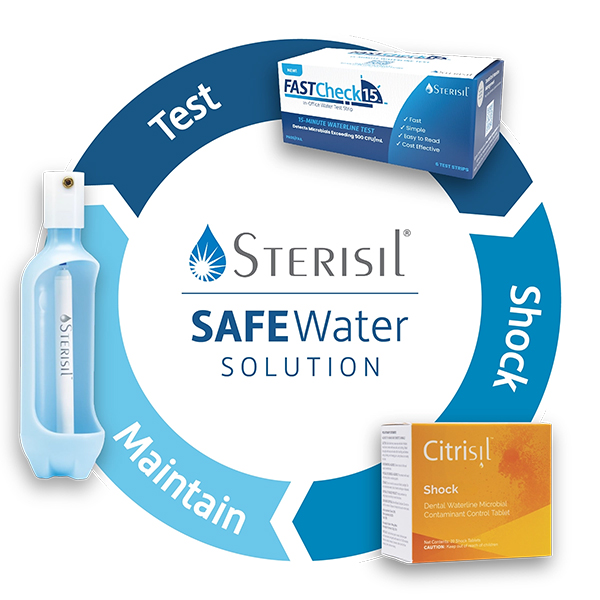
The Sterisil SAFEWater Solution is a quick, easy, and affordable 3-step dental unit waterline maintenance protocol that can be easily adapted to fit the Georgia dental unit waterline rule. Here’s what the SAFEWater Solution looks like in practice:
- Test: Test once per quarter with FASTCheck15®: a 15-minute, in-office waterline test.
- Shock: After you test, shock with Citrisil™ Shock (whether you pass or fail). Georgia’s rule highlights that you must remediate (and document your remediation) if you fail a test; you can use Citrisil Shock to remediate a failed test and for monthly preventative maintenance.
- Maintain: Replace your Silver Ion-powered Sterisil® Straw once per year to ensure your waterlines are receiving continuous, daily treatment.
Comment rédiger une lettre de motivation pour la formation sur les conduites d’eau dentaires
Create a simple waterline Standard Operating Procedure (SOP) your team can follow. It should include:
- Testing cadence and testing type (are you using an in-office test or a mail-in lab test? Does your office test monthly or quarterly?)
- Instructions for logging results (are you using a paper log or a digital portal to log results? What does your state’s rule require you to include in the log?)
- Product usage guides and the manufacturers’ Instructions For Use (IFUs)
- Who is responsible and accountable for infection control duties
Sterisil provides training videos and other resources to make this even easier.
Le soutien continu fait toute la différence
Your team doesn’t need to memorize everything. Use the My Solutions Center online portal to:
- Historique des essais sur piste
- Rappels du set
- Order refills or register for product subscriptons
- Get support from certified Water Safety Specialists
Navigating Georgia’s new Dental Waterline Rule may seem daunting at first, but with the right training, tools, and support, it quickly becomes part of your practice’s rhythm. By turning compliance into a structured, team-driven process—and tapping into trusted resources like Sterisil’s SAFEWater Solution—you’re not just meeting state requirements; you’re reinforcing your commitment to patient safety and clinical excellence.